

Key Takeaways
A Mercedes battery draining diagnosis starts by separating a weak battery from an electrical system that keeps drawing power after the vehicle is parked. A careful test can prevent repeated battery replacements and point toward a lasting repair.
- A healthy battery can still go flat when an abnormal parked-current draw remains active.
- Slow cranking, flickering lights, and overnight failure are useful diagnostic clues.
- The vehicle must be allowed to enter sleep mode before current draw is judged.
- Fuse testing, accessory checks, and module scanning help locate the circuit at fault.
- Charging-system testing and correct battery setup matter after the repair.
What causes a Mercedes battery to drain
Battery drain usually has more than one possible explanation. The battery may be worn out, the alternator may not be replenishing it, or a circuit may remain awake after the vehicle is locked. A Mercedes battery draining diagnosis works best when these possibilities are tested in a logical order rather than guessed from one symptom.
Parasitic electrical draw while parked
Every modern vehicle uses a small amount of electricity while parked for memory functions, security features, and other essential systems. The problem begins when a component draws considerably more than expected or fails to shut down. Common examples include a light that stays on, an accessory wired incorrectly, or a control module that repeatedly wakes up.
This is different from a single forgotten cabin light. The draw can be intermittent, which makes the vehicle appear normal during a brief inspection. A useful overview of parasitic battery drain can help explain why a battery may discharge even when nothing obvious has been left switched on.
Aging or undercharged batteries
A battery loses capacity as it ages, and extreme temperatures can make that weakness more noticeable. Repeated short trips may also leave it undercharged, especially when the vehicle uses substantial electrical power before the engine has run long enough to replace what was used during starting.
A marginal battery can therefore imitate a drain. If it has already been discharged several times, its ability to hold a charge may be reduced even after it is recharged. Testing the battery’s condition separately from the vehicle’s parked draw prevents the two problems from being confused.
Alternator and charging-system faults
A battery can go flat because it is not receiving enough charge while the engine is running. Possible causes include a charging fault, damaged wiring, poor grounds, or a control problem that changes how charging is managed. A warning light may appear, but it is not guaranteed to show at the moment the problem begins.
Short drives can hide a gradual charging problem. The car may start normally after a long journey and then fail after several brief trips. Comparing charging voltage under different electrical loads gives a more useful picture than checking one voltage reading at idle.
Infotainment, comfort, and control-module issues
Audio equipment, convenience features, and electronic modules can all contribute to a drain when they do not shut down correctly. A door or trunk latch that does not report its position accurately may keep interior functions active, while a software or communication fault can cause a module to wake repeatedly.
The visible symptom is not always located near the faulty circuit. An intermittent interior light, an accessory that stops responding, or a vehicle that seems unusually active after locking can all justify further testing. Avoid assuming that a new battery has solved the underlying issue.
Signs your Mercedes has a battery-drain problem
The pattern of failure often provides the first useful evidence. Note when the problem occurs, what the vehicle does before starting, and whether the symptoms appear after a short stop or a full night. These details help distinguish a battery that is simply tired from one being depleted by a continuing electrical load.

A single failed start does not prove parasitic draw, but repeated failures after parking deserve a measured diagnosis. The following signs are especially helpful when deciding what to test next.
Slow cranking and intermittent starting
A starter that turns slowly, clicks, or works normally one day and poorly the next may be seeing reduced battery capacity. If a jump-start restores operation temporarily but the same failure returns after parking, the battery, charging system, and parked draw should all be considered.
Intermittent starting can also result from loose connections or a failing starter circuit. That is why the symptom should be recorded rather than treated as proof of one particular fault.
Warning messages and electrical symptoms
Low system voltage can produce warning messages that disappear after the vehicle is driven or the battery is recharged. Interior lights may appear dim, windows may operate slowly, or electronic features may behave inconsistently. These signs are useful clues, but they do not identify the failed component by themselves.
Write down the exact message and when it appeared. A scan performed while the fault is present may reveal more than a scan taken after several successful drives.
Battery failure after sitting overnight
Overnight failure is a strong reason to check for a key-off current draw, particularly when the battery has recently passed a basic test. The timing can also reveal whether the issue is severe: a rapid failure points toward a larger load, while a slow decline may involve a modest draw, low battery capacity, or repeated undercharging.
Before drawing conclusions, confirm that the vehicle was fully closed and locked. A trunk, glovebox, or door that remained slightly open can create a simple but easily missed explanation.
Distinguishing battery drain from normal battery discharge
Some discharge while parked is normal. The practical question is whether the draw is within the vehicle’s expected range and whether the battery itself can still hold enough capacity. A battery that fails after a short period may be weak even when the measured parked draw is not excessive.
Compare the resting voltage, battery test results, and key-off current reading. Looking at all three prevents a normal standby load from being blamed for a battery that has reached the end of its service life.
How to prepare for a Mercedes battery draining diagnosis
Good preparation makes the test safer and more repeatable. Gather the vehicle history, charge the battery appropriately, and avoid opening doors or switching on equipment once the measurement process begins. A rushed test can wake modules and produce a reading that does not reflect normal parked conditions.
Confirm the battery’s age and condition
Find the battery’s installation date if it is available, then inspect the case, terminals, and visible connections. A swollen or damaged battery should not be tested casually. A proper battery tester can assess starting performance and condition more reliably than voltage alone.
If the battery is deeply discharged, charge it before investigating a subtle drain. Otherwise, the vehicle may be tested with too little reserve, and the result may be misleading.
Check recent repairs, accessories, and driving habits
Recent electrical work is a valuable clue, especially if the problem began soon afterward. Ask whether a tracker, alarm, dash camera, charger, audio component, or other accessory was installed. Also record whether the vehicle is used mostly for short journeys or sits unused for several days.
A simple history can narrow the search quickly. Keep track of jump-starts, battery replacements, warning messages, and the length of time the car usually sits before failing.
Gather a multimeter and essential safety equipment
Use a suitable digital multimeter, insulated leads, eye protection, and gloves where appropriate. Current testing can damage a meter if the leads are placed in the wrong sockets or if the vehicle load exceeds the meter’s rating. Read the meter instructions before connecting it in series with the battery.
Do not work around moving belts or a running engine during a key-off draw test. If the procedure or connection method is unclear, a qualified technician is the safer choice.
Allow the vehicle to enter sleep mode
After switching the vehicle off, close or latch the access points as the vehicle normally would and keep the key away from it. Wait for the interior systems and modules to settle before judging the reading. The required wait can vary with the vehicle’s equipment and condition.
Avoid pressing the remote, opening a door, or touching the trunk during this period. Any of those actions may wake the network and force the settling process to begin again.
How to test for parasitic battery drain
A current-draw test measures what the vehicle takes from the battery after it is switched off and allowed to settle. The order matters: establish the battery’s condition first, connect the meter correctly, and then wait for sleep mode. Readings taken too soon can send the diagnosis in the wrong direction.
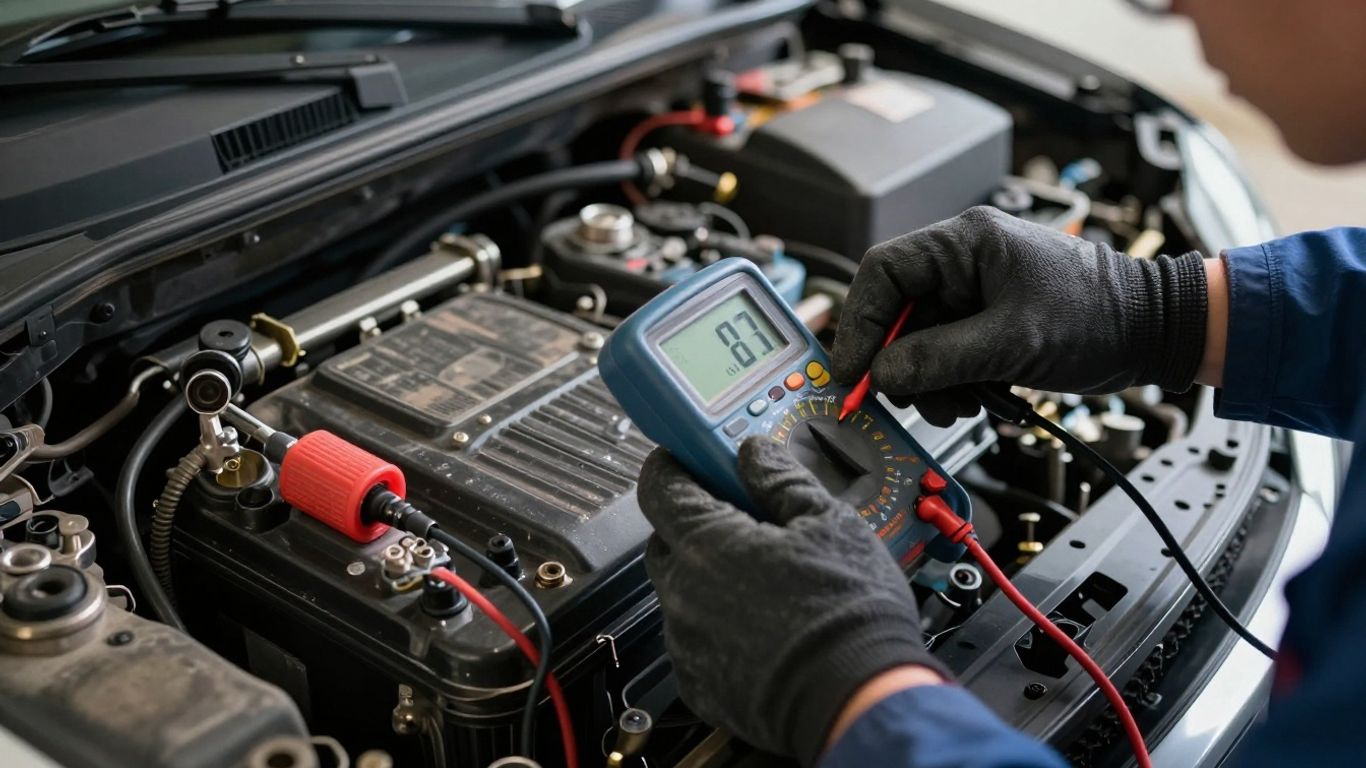
Use the test as an investigation, not as a pass-or-fail judgment based on one universal number. Vehicle equipment, battery condition, and module behavior all affect the result.
Measure the battery’s resting voltage
Let the vehicle sit with the ignition off, then measure voltage directly at the battery terminals. A fully charged battery will generally show a higher resting voltage than one that is partly discharged, but voltage is only a starting point. Surface charge and recent charging can make the first reading look better than the battery’s real condition.
For a clearer result, allow the battery to rest and compare readings over time. A voltage drop after the vehicle has been parked may support the suspicion of drain, but it still does not identify the circuit responsible.
Perform a key-off current draw test
Set up the meter according to its instructions and place it in series with the battery connection, taking care not to interrupt the circuit unnecessarily. Lock or secure the vehicle as appropriate, keep the key away, and wait until the reading stabilizes. Record both the initial value and the settled value.
The process is safer when all doors and compartments are prepared beforehand. If disconnecting the battery would cause unwanted resets or the meter cannot handle the expected load, use a professional current clamp or diagnostic procedure instead.
Identify an abnormal amperage reading
There is no single number that applies to every vehicle configuration, so compare the settled reading with the manufacturer’s specifications or a qualified technician’s reference. A clearly elevated reading after sleep mode suggests that something remains active. A fluctuating reading may indicate a module waking periodically rather than a constant fault.
Record the conditions surrounding the measurement, including battery state and elapsed settling time. The timing of the reading matters as much as the number itself because a premature measurement can capture normal shutdown activity.
Avoid disrupting Mercedes control modules during testing
Modern electrical networks may react when the battery is disconnected, a fuse is pulled, or a door is opened. That reaction can wake modules, erase useful conditions, or create new fault messages. Keep the vehicle undisturbed and use a test method that preserves power when possible.
If the reading changes after an interruption, allow the vehicle to settle again before interpreting it. A stable, repeatable test is more valuable than a quick result collected while the system is still active.
How to isolate the source of the drain
Once an abnormal draw is confirmed, the next task is finding the circuit that remains active. Work methodically and change one condition at a time. Randomly pulling multiple fuses or disconnecting several accessories can hide the original behavior and make the results difficult to reproduce.
Check fuses and circuits systematically
With the current reading monitored, remove or test one fuse at a time using the vehicle’s documented fuse layout. A meaningful drop in current points toward the circuit supplied by that fuse, not necessarily the exact component that has failed. Several components may share one circuit.
Record each fuse tested and the change observed. This small amount of documentation avoids repeating steps and gives a technician a useful starting point if the fault requires deeper circuit testing.
Inspect aftermarket alarms, trackers, and chargers
Non-factory accessories deserve early attention because wiring, placement, and configuration can affect whether they shut down with the vehicle. Check hard-wired chargers, cameras, tracking devices, alarms, and illuminated accessories for poor connections or continued activity.
Do not simply cut a wire or remove a device without understanding how it was installed. Disconnect one accessory at a time, repeat the sleep-mode test, and confirm that the vehicle’s other functions remain intact.
Test doors, trunk latches, and interior lights
Inspect every latch and switch that tells the vehicle an opening is closed. A light that remains on may be visible, but a faulty position signal can keep other systems awake without an obvious lamp. Check the glovebox, trunk, rear compartments, and folding seats where fitted.
Use the current reading to confirm whether manipulating a latch changes the draw. The goal is to connect the physical observation with an electrical change rather than relying on appearance alone.
Scan control modules for faults and wake-up events
A diagnostic scan may reveal communication faults, stored low-voltage events, or a module that is not completing its shutdown routine. Scan results should be interpreted alongside the current measurement because a stored code does not automatically mean that the module is the source of the drain.
If the draw is intermittent, repeated scans or longer observation may be needed. A technician may monitor the network while the vehicle is parked to see which system wakes and whether that event matches the timing of the battery loss.
How to diagnose the charging system
A battery-drain investigation is incomplete until the charging system has been checked. A vehicle can have a normal parked draw and still lose starting power because the battery is not being replenished. Test the system with a charged battery and compare results under realistic electrical demand.
Test alternator output under different loads
Measure charging behavior at idle and while appropriate electrical loads are operating. Look for output that is lower than expected, unstable, or slow to respond when demand changes. A single reading with every accessory switched off may miss a fault that appears under load.
Follow the vehicle’s specifications for the acceptable range and test conditions. Charging strategy can vary, so avoid treating a fixed voltage target as universal.
Inspect battery cables and ground connections
Look for loose, corroded, damaged, or overheated terminals and cables. Pay particular attention to the negative path and the engine or body ground connections. Resistance in a cable can limit charging and starting even when alternator output appears acceptable at the alternator itself.
Voltage-drop testing under load can reveal a poor connection more clearly than a visual inspection. Clean and secure connections only after the vehicle is made safe for the work.
Check the voltage regulator and charging control
Charging may be regulated electronically rather than held at one constant output. A regulator or control fault can cause undercharging, overcharging, or inconsistent behavior. Compare the measured response with the specified test procedure for the vehicle.
Do not condemn the alternator solely because the battery is low. The fault may be in control wiring, a sensor, a connection, or another part of the charging circuit.
Evaluate the battery with a professional tester
A professional tester can assess starting capability and battery condition after the battery has been charged. This matters because a battery that has been repeatedly drained may no longer recover its original capacity. Replace it only after the cause of the discharge has been addressed or tested.
If a new battery is installed before the draw is repaired, the replacement may suffer the same treatment. Test the repaired vehicle again after it has completed its normal shutdown cycle.
How to fix and prevent recurring battery drain
The repair should address the reason the battery became depleted, not only the depleted battery itself. Confirm the fault, repair the circuit or component, and repeat both charging and parked-draw checks. Prevention then depends on how the vehicle is used and whether it will sit for extended periods.
Repair or replace the failed component
Repair damaged wiring, correct poor accessory connections, replace a failed switch or module, or resolve the charging fault identified by testing. The appropriate fix depends on the circuit and evidence gathered during isolation. Avoid replacing unrelated parts simply because they are easy to access.
After the repair, clear any relevant fault conditions only when appropriate and verify that the system enters sleep mode. A repeat measurement provides stronger confirmation than a successful start immediately after the work.
Register or code a replacement battery when required
Some vehicles require the battery replacement to be recorded or configured so that charging management matches the battery’s type and capacity. Follow the specified service procedure for the vehicle rather than assuming every replacement is handled identically.
Correct setup does not repair a parasitic draw, but it helps the charging system manage a properly installed battery. Confirm the battery specification and installation details before completing the job.
Maintain the battery during long periods of storage
When a vehicle will sit for weeks, plan how its battery will be maintained. A suitable approved maintainer may help, provided it is connected safely and is compatible with the vehicle and battery. Keep the vehicle secure and follow the maintainer’s instructions.
If the battery repeatedly loses charge while stored, do not treat maintenance charging as a substitute for diagnosis. Persistent loss still calls for a parked-draw and charging-system check.
Reduce avoidable electrical loads and short trips
Remove chargers and portable accessories when they are not needed, close every compartment fully, and avoid repeated very short journeys when possible. Longer drives may give the charging system more time to replenish starting energy, though they will not correct a defective component.
A simple prevention routine includes these checks:
- Confirm that doors, the trunk, and the glovebox are fully closed.
- Unplug accessories that can remain energized while parked.
- Watch for slow cranking or electrical warnings before the battery fails.
- Keep the battery charged when the vehicle is unused for long periods.
These habits reduce avoidable discharge, while a repeat test confirms whether the original fault has actually been resolved.
Conclusion
A Mercedes battery draining diagnosis is most reliable when it tests battery condition, charging performance, and key-off current draw as separate parts of the same investigation. Allowing the vehicle to sleep, recording each result, and isolating one circuit at a time can turn a frustrating overnight failure into a traceable repair.
Frequently Asked Questions
What is parasitic battery drain?
Parasitic drain is electrical current that continues flowing after the vehicle is switched off and its systems should have settled. A small standby draw is normal; the concern is an unusually high or persistent draw that depletes the battery.
Can a new battery keep going flat?
Yes. A new battery can discharge if an electrical circuit remains active, if the charging system is faulty, or if the vehicle is used mainly for short trips. Replacing the battery alone may not remove the underlying cause.
How long should a vehicle sit before a current-draw test?
It should sit long enough for its modules to enter sleep mode. The exact time varies by vehicle and equipment, so follow the applicable service information and confirm that the reading has stabilized before interpreting it.
Can a weak battery look like a parasitic drain?
Yes. A battery with reduced capacity may fail after sitting even when the vehicle’s parked draw is normal. Resting voltage, a battery-condition test, and a current-draw test should be considered together.
What accessories commonly cause battery drain?
Hard-wired cameras, chargers, tracking devices, alarms, and other aftermarket equipment can cause problems when installed incorrectly or left energized. Disconnect and test one accessory at a time rather than removing several at once.
Does driving recharge a completely dead battery?
Driving may replenish some charge, but it is not a dependable way to recover a deeply discharged or damaged battery. Use an appropriate charger and test the battery and charging system before relying on the vehicle again.
When should a professional diagnose the problem?
Seek professional help when the battery is damaged, current testing is unfamiliar, the vehicle has complex electronic systems, or the drain is intermittent. Incorrect connections can damage equipment or disrupt vehicle modules.