

Key Takeaways
An exhaust leak can begin as a small change in sound but develop into a safety, emissions, or engine-management problem. Early inspection usually means a simpler Mercedes exhaust leak repair.
- Listen for hissing, tapping, popping, or a suddenly louder exhaust.
- Treat exhaust fumes in the cabin as an urgent warning.
- Leaks may come from manifolds, gaskets, pipes, flex sections, or muffler joints.
- Diagnosis often combines a visual inspection, smoke test, and scan-tool data.
- Repair cost depends on access, corrosion, parts, labor, and the damaged component.
How to recognize a Mercedes exhaust leak
Exhaust leaks do not always announce themselves with a dashboard warning. Often, the first clue is a different sound during startup or acceleration, followed by an odor or gradual change in drivability. Pay attention to when the symptom occurs and whether it is louder when the engine is cold.
Common sounds and smells
A leak near the engine may sound like a sharp tick, puff, or tapping noise, while a hole farther underneath can create a deeper rumble. Hissing often points to escaping gas at a joint or crack. An exhaust odor around the vehicle is also a concern, particularly if it becomes noticeable inside the cabin.
The sound can change as metal heats and expands, so a quiet car after five minutes of driving may still have a leak. A useful Mercedes exhaust leak symptom guide can help you compare unusual noises, smells, and fuel-economy changes before booking an inspection.
Warning lights and dashboard messages
An exhaust leak ahead of an oxygen sensor can allow outside air to reach the sensor and distort its readings. The engine computer may then store a fault code or illuminate the check-engine light, although not every leak triggers a warning. A dashboard message should be treated as supporting evidence, not as a precise location for the leak.
Record any related symptoms, such as rough running, a sulfur-like odor, or a light that appears only after highway driving. The combination gives a technician more direction than the warning light alone.
Performance and fuel economy changes
A leak can alter exhaust pressure and oxygen-sensor information, especially when it occurs close to the engine. Some drivers notice hesitation, reduced responsiveness, roughness, or a drop in fuel economy. Those symptoms can also come from ignition, intake, or fuel-system faults, so they should not be used to diagnose the exhaust by themselves.
Keep a simple note of fuel use and driving conditions for a week if the change is gradual. That record can help separate a genuine pattern from the normal variation caused by traffic, weather, or tire pressure.
When an exhaust leak becomes unsafe
Safety becomes the priority when fumes enter the cabin, the exhaust pipe hangs low, or a damaged section is close to heat-sensitive wiring and underbody materials. Carbon monoxide has no reliable smell, so the absence of odor does not make cabin exposure safe. Headache, dizziness, nausea, or unusual tiredness while driving calls for immediate ventilation and stopping in a safe place.
Do not crawl beneath a car supported only by a jack. A professional inspection is safer and can identify both the leak and any risk created by loose or overheated components.
What causes exhaust leaks in Mercedes vehicles
The exhaust system works through a chain of flanges, gaskets, pipes, brackets, sensors, and heat-exposed components. A failure at one connection can put extra movement or stress on the parts around it. Age, repeated heat cycles, road debris, moisture, and salt all contribute.
The most useful first question is where the leak begins: at the engine, beneath the passenger compartment, or near the rear silencer. That location narrows the likely repair without assuming that a loud tailpipe is the source.
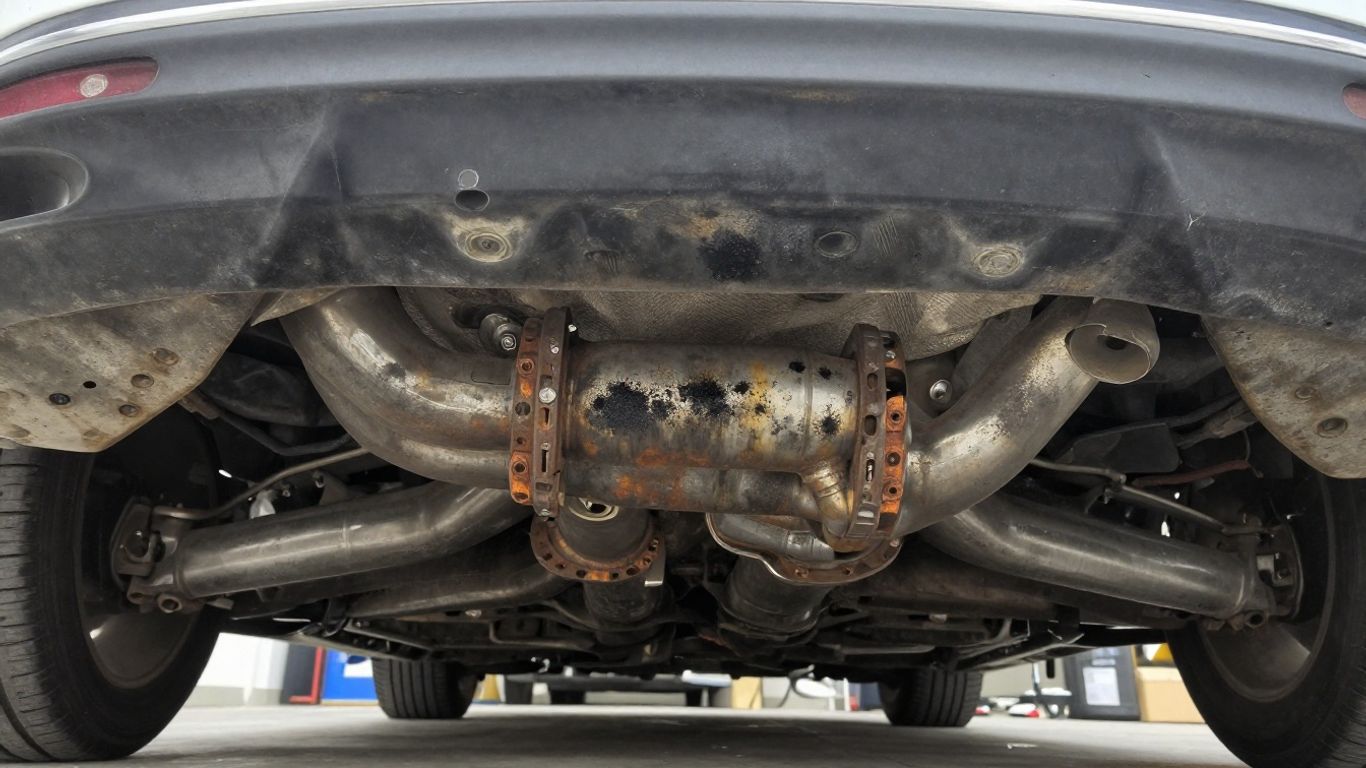
Cracked exhaust manifolds and headers
Manifolds operate in one of the hottest areas of the vehicle and are exposed to constant expansion and contraction. A crack may produce a ticking sound during a cold start, soot marks around the casting, or an odor near the front of the engine bay. Broken heat shields can create similar noises, so confirmation matters.
A technician may inspect the manifold, mounting surfaces, and nearby fasteners together. Replacing only an external shield will not resolve a leak from a cracked casting.
Failed gaskets and broken fasteners
Flange gaskets flatten and lose their seal over time, while studs and bolts can weaken from heat and corrosion. A loose connection may leak only under acceleration, when the exhaust system moves and pressure rises. Soot around a flange is a helpful clue, though a clean-looking joint can still leak.
Repair normally requires separating the joint, checking both mating surfaces, and replacing damaged hardware rather than simply tightening an old fastener. For broader maintenance thinking, a root cause health evaluation is an unrelated but useful reminder that treating the visible symptom alone may miss the underlying failure.
Rust, corrosion, and damaged exhaust pipes
The underside of a vehicle sees water, salt, gravel, and frequent temperature changes. Corrosion can create pinholes, split seams, or weak areas around hangers. A road impact may flatten a pipe or shift it against the body, producing both a leak and a rattle.
Surface rust is not automatically a reason to replace an entire system. The technician must judge the remaining metal, the position of the damage, and whether nearby sections are too thin to support a lasting repair.
Worn flex pipes, mufflers, and catalytic converter connections
Flex pipes absorb movement between the engine and the rest of the exhaust. Their woven outer material can fray while the inner bellows crack, often causing noise and soot near the flexible section. Muffler seams and catalytic-converter connections can fail in similar ways, especially when brackets or hangers no longer support the system correctly.
Because emissions components have specific legal and fitment requirements, a repair near a catalytic converter deserves more care than a simple rear-pipe patch. A pantry pest inspection guide obviously concerns a different kind of inspection, but its basic principle applies here: locate the source before choosing the remedy.
How mechanics diagnose the leak
Good diagnosis is more than listening to the car in the service bay. The mechanic needs to locate the escape point, determine whether there are multiple leaks, and check whether the problem has affected sensors or nearby components. The vehicle may need to be cold for one part of the inspection and warm for another.
A proper Mercedes exhaust leak repair estimate should identify the failed section rather than rely on a general description such as “exhaust noise.”
Visual inspection from the engine to the tailpipe
The inspection typically follows the entire exhaust route, beginning at the manifold and continuing through the catalytic converter, flex sections, mufflers, joints, hangers, and tailpipe. Technicians look for soot trails, cracks, missing hardware, crushed pipe sections, and contact marks against the underbody.
They also check heat shields and brackets because a loose shield can imitate a leak. The car must be raised securely, with enough access to see the upper surfaces of pipes and flanges.
Smoke testing and pressure testing
A smoke machine can introduce a visible vapor into the exhaust system so it escapes through a crack or poorly sealed joint. Light pressure may also be used to make a small leak easier to observe, but the system should be tested carefully to avoid stressing components or seals.
Smoke testing is especially useful when the leak is quiet, hidden above a shield, or difficult to reproduce by ear. The result should still be compared with a visual inspection before parts are ordered.
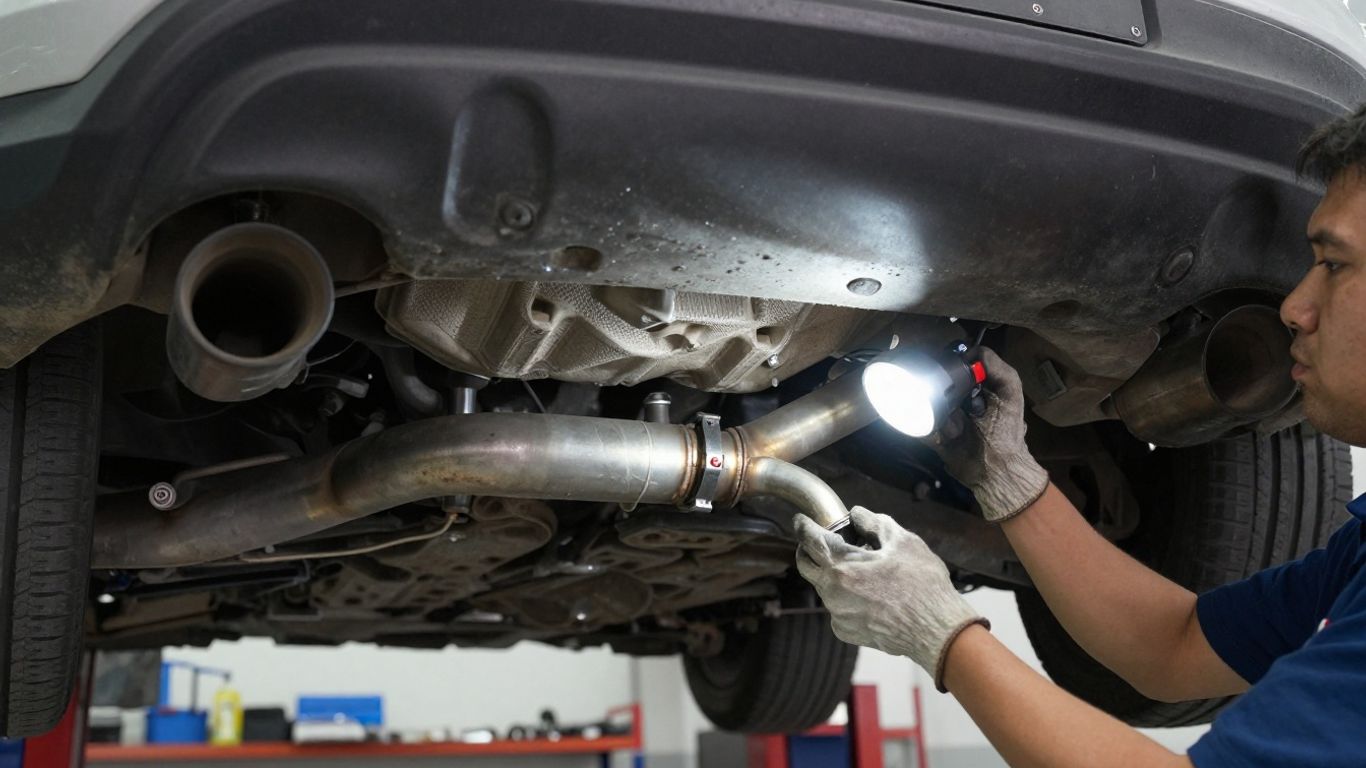
Using scan tools to check oxygen sensor readings
A scan tool can show stored fault codes and live oxygen-sensor data. Patterns that suggest an air leak may help the technician focus on the front part of the exhaust, but scan data does not replace a physical test. Vacuum leaks, fuel problems, sensor faults, and ignition issues can create overlapping readings.
The strongest diagnosis combines the electronic evidence with the exact location of soot, smoke, noise, or damaged metal. That avoids replacing a sensor when the underlying issue is a leaking flange.
Distinguishing an exhaust leak from other engine noises
A ticking noise may come from valve-train components, injectors, a loose heat shield, or an accessory, not just the exhaust. Mechanics listen during cold start, idle, and light acceleration, then compare the sound with what they see underneath. The timing and location of the noise are often more revealing than its volume.
A video guide on muffler and exhaust pipe repair can explain common inspection ideas, but catalytic-converter work and welding may require equipment and expertise beyond a driveway repair.
Mercedes exhaust leak repair options
The correct repair depends on the size, location, and condition of the failed part. A small gasket failure may be straightforward, while a corroded assembly can turn a short job into a careful replacement. The aim is a sealed system that is properly supported and safely separated from heat-sensitive parts.
Before approving work, ask whether the recommendation addresses one leak or the condition of the surrounding exhaust. Replacing a gasket against badly eroded metal may only postpone the next failure.
Replacing exhaust gaskets and seals
Gasket replacement is appropriate when the connected flanges remain flat and strong enough to clamp a new seal. The old gasket is removed, the surfaces are cleaned and checked, and new hardware may be installed if the original fasteners are stretched or corroded.
A quality repair also checks alignment. If the pipes are forced into position, vibration can quickly damage the replacement gasket.
Welding or replacing damaged pipes
A sound section of pipe with a localized hole may be repairable by welding, provided there is enough solid metal around the damage. Extensive corrosion, crushed tubing, or a split along a seam usually makes replacement more dependable. The repair must preserve the correct routing and clearance.
A patch that looks neat from below is not necessarily durable if the surrounding metal is paper-thin. The technician should inspect the adjacent section before deciding.
Repairing flex pipes and muffler sections
Flex pipes are often replaced as a section because their internal bellows cannot be restored reliably with an external patch. Muffler repairs vary: a small seam may be welded, while a rusted shell or broken inlet requires a replacement muffler. Hangers and brackets should be repaired at the same time if they caused excess movement.
The exhaust should sit without tension once the job is complete. That final fit reduces vibration and protects the new repair.
Replacing manifolds, catalytic converters, or complete assemblies
A cracked manifold, failed catalytic converter, or broadly corroded system may require component or assembly replacement. These parts can be expensive, and catalytic converters also involve emissions rules, sensor fitment, and correct calibration. The estimate should clearly name the part and explain why replacement is necessary.
A complete assembly is not automatically the best answer. If only one section has failed and the rest is structurally sound, a targeted repair may provide better value.
Mercedes exhaust leak repair cost factors
There is no reliable single price for exhaust work without seeing the vehicle. Labor access, the model’s layout, the location of the leak, and the condition of the fasteners can change the estimate quickly. A small rear-pipe repair and a front manifold replacement are very different jobs.
When comparing quotes, check whether diagnosis, hardware, taxes, and any follow-up work are included. General exhaust repair cost information can provide context, but it should not be treated as a quote for a particular Mercedes.
Parts and labor differences by Mercedes model
Models differ in engine layout, exhaust routing, shielding, sensor arrangement, and available working room. A component that is easy to reach on one vehicle may be tucked behind other parts on another. Labor time can therefore matter as much as the part itself.
Location also affects shop rates and parts availability. Ask for a written estimate that identifies the vehicle, failed component, labor operation, and warranty terms.
Repairing versus replacing an exhaust component
Welding can cost less when the surrounding pipe is healthy and the leak is localized. Replacement is usually more sensible when corrosion is widespread, a flange is distorted, or the component has already been repaired once. The cheapest initial option can become expensive if it fails again soon.
A technician should explain the expected durability of each option. That gives you a practical choice rather than a price comparison stripped of context.
OEM, aftermarket, and used-part considerations
Original equipment parts generally offer the closest fit and specification, while aftermarket parts may provide a lower-cost alternative with varying materials and warranties. Used parts can make sense for some hard-to-source components, but their remaining corrosion and service life need careful assessment.
Ask whether the part carries the correct emissions certification for the vehicle and region. Fit, sensor compatibility, and warranty coverage matter more than the label alone.
Additional costs for rusted bolts and damaged hardware
Seized bolts, snapped studs, broken hangers, and damaged heat shields can add time to an otherwise simple repair. Removing corroded hardware may require extraction, drilling, or replacement of nearby brackets. The estimate can change after the joint is opened because hidden damage is then visible.
That uncertainty is normal with older underbody components. A trustworthy shop will distinguish confirmed work from possible additional labor instead of presenting every contingency as certain.
Can you drive with a Mercedes exhaust leak?
The answer depends on the leak’s location and severity, but continued driving is not a good way to monitor a suspected failure. A leak near the cabin, engine bay, or catalytic converter deserves more urgency than a small rear muffler hole. Even a quiet leak can worsen as heat and vibration continue.
If you must move the vehicle a short distance for safety, keep the trip brief and arrange professional inspection promptly. Do not use temporary sealants as a substitute for a structural repair.
Carbon monoxide and cabin air risks
Exhaust gases can enter through body openings, ventilation paths, or a damaged floor area. Carbon monoxide is particularly dangerous because it is colorless and odorless. If anyone feels dizzy, confused, weak, or unusually sleepy in the vehicle, stop, leave the cabin, and seek emergency help as appropriate.
Driving with the windows open is not a dependable solution. Airflow can change with speed, traffic, and the operation of the ventilation system.
Effects on engine performance and emissions
A leak can affect oxygen-sensor readings, noise levels, emissions performance, and fuel economy. It may also expose nearby components to hot gases. The resulting check-engine light can obscure a second problem if the vehicle continues to be driven without diagnosis.
Performance changes are a reason to arrange service, not proof that a particular part has failed. Testing is still needed to separate an exhaust issue from other engine faults.
Situations that require immediate towing
Tow the vehicle rather than drive when fumes are present in the cabin, the exhaust is dragging, the engine bay has visible smoke, or a major pipe has separated. Towing is also sensible when the car is running poorly enough to create a traffic hazard or when warning lights are accompanied by severe symptoms.
Professional exhaust services may advertise exhaust leak inspections and repairs, but the practical rule is simple: choose a qualified local shop and do not keep driving a vehicle that may be filling with fumes.
Temporary precautions before professional repair
Park outdoors when possible and avoid idling in a garage or enclosed area. Keep passengers out of the vehicle if fumes are suspected, and do not touch hot exhaust components. If the car must be moved, arrange the shortest possible route directly to a repair facility or use a tow service.
These steps only reduce immediate exposure; they do not make the vehicle safe for normal use. A hail-damage prevention guide is about a different system, but it similarly illustrates why inspection after physical damage should not be delayed.
How to prevent future exhaust leaks
No exhaust system lasts forever, but routine attention can catch weakened parts before they become noisy failures. Prevention is mostly about noticing changes early, protecting the underbody, and making repairs that restore proper support. It also means using a shop willing to inspect the complete system.
A small record of previous repairs, corrosion, and unusual sounds can help reveal recurring stress at the same joint or hanger. That history is useful during future service visits.
Following Mercedes maintenance intervals
Follow the maintenance schedule for the vehicle and ask for an underbody inspection when the car is already on a lift. Routine service is an opportunity to spot loose brackets, rust, damaged shields, and early gasket seepage. It is much easier to address a weak hanger before it pulls on a pipe.
Maintenance intervals do not guarantee that a leak will not occur. They simply create regular opportunities to find developing problems.
Inspecting the exhaust after road impacts
After striking a pothole, curb, or piece of road debris, listen for a new rattle and check whether the tailpipe sits lower than before. A visible change in alignment can indicate a bent pipe or broken hanger even when there is no immediate leak. Have damage checked before corrosion spreads around the impact point.
Do not reach under a recently driven vehicle. Let it cool and use proper lifting equipment, or have a professional perform the inspection.
Addressing rust and underbody damage early
Washing salt and grime from the underside can slow the buildup of corrosive residue, especially after winter driving. Early surface rust deserves observation, while flaking metal, split seams, and perforations call for repair planning. Nearby shields and brackets should be included in the assessment.
A preventive inspection is also wise after long storage, flooding, or repeated driving on heavily salted roads. Early attention usually costs less than repairing several connected failures.
Choosing a qualified Mercedes repair shop
Choose a shop that can safely lift the vehicle, perform leak testing, interpret scan data, and explain whether a component can be repaired or needs replacement. Ask for photographs or a clear description of the failed area, along with the part brand, labor estimate, and warranty.
For a broader service perspective, European exhaust repair specialists describe the value of diagnostics and inspection, though every shop should be judged by its actual credentials, workmanship, and communication.
Conclusion
A Mercedes exhaust leak should not be ignored simply because the car still drives. Sound, odor, warning lights, and changes in performance can point toward a problem, but a careful inspection is what identifies the real repair. Addressing the leak early protects occupants, emissions components, and the rest of the exhaust system while keeping the final bill more predictable.
Frequently Asked Questions
What does an exhaust leak sound like?
Common sounds include hissing, tapping, popping, or a deeper-than-normal rumble. The noise may be strongest during cold starts or acceleration and can change as the exhaust heats up.
Can an exhaust leak cause a check-engine light?
Yes. A leak near an oxygen sensor can affect the readings used by the engine computer and may trigger a fault code. A warning light can have many causes, so testing is required.
Is an exhaust leak dangerous?
It can be dangerous if gases reach the cabin, if hot exhaust contacts nearby components, or if a loose pipe drags beneath the vehicle. Suspected fumes inside the cabin require immediate attention.
How is an exhaust leak diagnosed?
A mechanic may inspect the system visually, listen during different operating conditions, use smoke or pressure testing, and review oxygen-sensor data with a scan tool.
Can a small exhaust leak be welded?
Sometimes. Welding is suitable only when the surrounding metal is strong enough and the damaged area is localized. Widespread corrosion usually calls for component replacement.
How long can a car be driven with an exhaust leak?
There is no safe universal time limit. A small rear leak may allow a short trip to a repair shop, while cabin fumes, a separated pipe, or severe symptoms warrant towing.
How much does exhaust leak repair cost?
Cost varies with the vehicle, failed component, access, parts, corrosion, and labor. A written estimate after inspection is more useful than a broad average.