

Key Takeaways
A rough idle is a symptom, not a diagnosis. Start by observing when it happens, then check air, fuel, ignition, and mechanical causes in a sensible order.
- Note whether the vibration appears cold, warm, or all the time.
- Scan for fault codes before replacing parts.
- Inspect vacuum hoses, ignition components, and intake connections.
- Treat a flashing check engine light as an urgent warning.
- Use professional testing when compression, timing, or fuel pressure may be involved.
What a rough idle feels like in a Mercedes
A smooth engine should settle into a steady rhythm when the vehicle is stopped. Rough idling can feel like a tremor through the seat or steering wheel, an uneven engine note, or a repeated rise and fall in engine speed. The symptom may be mild at first, but its timing and pattern often provide useful clues.
Common symptoms to identify
Pay attention to what you can feel, hear, and see rather than relying only on the dashboard. A stumble when selecting Drive, a faint popping sound, or a hesitation as the engine settles can all point toward an unstable combustion event. The rough idle symptoms guide also highlights shaking, popping noises, warning lights, worn spark plugs, weak coils, and vacuum leaks as useful clues.
Record whether the engine runs smoothly at higher speeds. A problem that is obvious only at idle may involve an air leak or airflow control issue, while a fault that worsens under acceleration deserves broader testing.
How idle speed and engine vibration relate
The tachometer can show an idle that is too high, too low, or continually moving. Those changes matter, but vibration alone does not prove that engine speed is abnormal. Worn mounts, for example, can transmit normal engine pulses into the cabin, while a misfire may produce both an uneven RPM reading and a noticeable shake.
Compare the sound of the engine with the movement of the needle. The pattern matters more than one isolated reading, especially when electrical loads, air conditioning, or transmission engagement briefly change the idle.
When rough idling occurs only after startup
A cold-start-only complaint often deserves a different line of investigation from a fault that appears after the engine reaches operating temperature. Cold air, fuel enrichment, intake leaks, weak ignition parts, and diesel glow-system problems can all make the first minute feel unsettled.
If the idle improves as the engine warms, note exactly how long that takes and whether the weather changes the symptom. A short recording of the tachometer and engine sound can help a technician reproduce the condition without guessing.
Signs that the engine may stall
Near-stalling is more serious than a small vibration. The engine may dip sharply in speed when you stop, recover after a moment, or actually shut off when accessories or the transmission add load. Hesitation when pulling away can make the vehicle unpredictable in traffic.
Switch off unnecessary driving if the engine repeatedly dies, backfires, or cannot maintain a steady idle. A specialist guide on Mercedes rough idling and stalling describes excessive shaking, RPM fluctuation, vacuum leaks, poor acceleration, and misfires as symptoms that merit prompt attention.
The most common causes of Mercedes rough idling
Mercedes rough idle problems can begin with a small air leak, an aging ignition part, contaminated airflow hardware, or a delivery problem in the fuel system. Different engines use different control strategies, so the same sensation may have several possible causes. Diagnosis is more reliable when the symptom is paired with scan data and a physical inspection.
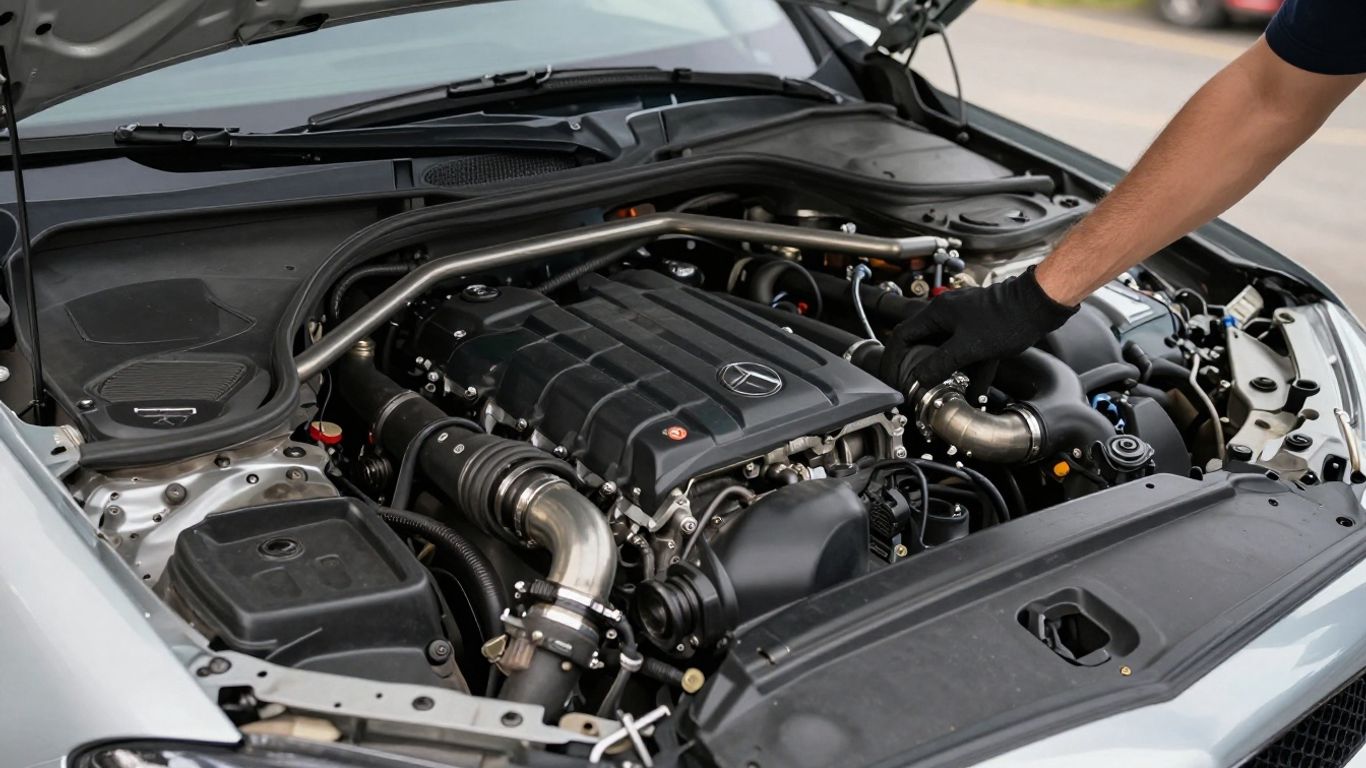
Vacuum leaks and intake system faults
An intake leak allows air into the engine without being measured as expected. The resulting mixture may be too lean, particularly at idle, when even a small leak can have a large effect. Split hoses, loose clamps, damaged seals, and cracked intake plumbing should all be considered.
Look for a high or wandering idle, hesitation, or misfire codes that are more noticeable when the engine is cold. Do not assume that every hiss is a leak, though; a smoke test is usually safer and more conclusive than spraying flammable materials around a running engine.
Failing spark plugs, ignition coils, or injectors
A worn spark plug or weak coil can leave one cylinder contributing less than the others. The result may be a rhythmic shake, an uneven exhaust note, and a fault code identifying a cylinder or misfire pattern. An injector problem can feel similar, although it may also affect starting, fuel economy, or exhaust odor.
Parts should be tested or compared before replacement. Replacing every coil at once may be unnecessary, and changing plugs will not correct an injector or wiring fault.
Dirty throttle body or mass airflow sensor
The throttle body helps regulate the air entering the engine, while the airflow sensor supplies information used to calculate fueling. Dirt or residue can interfere with airflow measurement or throttle response. Carbon buildup is another possible angle on some direct-injection engines; the carbon buildup explanation connects deposits with disrupted airflow, combustion, misfires, and declining fuel economy.
Cleaning can help when contamination is actually present, but the correct cleaner and procedure depend on the component. A sensor should not be handled roughly, and electronic throttle units may require adaptation after approved service.
Fuel pressure and fuel delivery problems
Low or unstable fuel pressure can make an engine stumble at idle, especially when demand changes. A restricted filter, tired pump, faulty pressure regulator, injector issue, or poor electrical connection may be involved. Diesel systems add their own high-pressure and metering considerations.
Fuel pressure should be measured with suitable equipment rather than inferred from sound alone. If pressure falls outside specification, the next step is to isolate the cause instead of installing a pump as a guess.
Engine mounts that amplify normal vibration
A mount can deteriorate while the engine continues to run correctly. Excess movement or a collapsed mount transfers vibration into the body, often most clearly at a stop or when shifting between Park, Reverse, and Drive. The tachometer may remain steady in this case.
A visual inspection can reveal sagging, leaking hydraulic fluid, or unusual movement, but mount diagnosis should also account for the engine’s actual running quality. Repairing a mount will not fix a misfire, and tuning work will not repair a failed mount.
How to diagnose a Mercedes rough idle
Good diagnosis moves from information gathering to targeted testing. Begin with the driver’s observations, warning lights, service history, and stored codes, then confirm the suspected system with live data or physical tests. This avoids the expensive habit of changing several unrelated parts at once.
Reading diagnostic trouble codes
A scan tool may reveal misfire, mixture, airflow, throttle, fuel-pressure, or sensor-related codes. A code points toward a system or condition; it does not automatically identify the failed component. Freeze-frame information can show the engine temperature, load, and speed when the fault was recorded.
Read pending and stored codes before clearing anything. Clearing them too early can remove useful evidence and make an intermittent issue harder to reproduce.
Checking live data with a scan tool
Live data can show whether engine speed, fuel corrections, airflow, temperature, and misfire counters behave consistently. Compare readings at cold start, warm idle, and with a modest accessory load. A technician can also look for one cylinder that repeatedly falls behind the others.
Data becomes useful when it is compared with expected values and with the physical symptoms. One unusual number is not enough to condemn a sensor, particularly if a wiring or air leak could be creating the same result.
Testing for vacuum and intake leaks
A smoke test is a practical way to find leaks that are difficult to see. Inspect the intake boot, small vacuum lines, crankcase ventilation plumbing, manifold seals, and connections near the throttle body. Listen for hissing, but remember that some leaks are silent.
Do not overlook a loose airbox lid or a distorted filter seal. Any opening after the airflow sensor can affect the mixture and create symptoms that look like an ignition problem.
Inspecting ignition and fuel system components
Remove and inspect spark plugs for wear, fouling, damage, or differences between cylinders. Check coil connections and wiring, then verify fuel pressure and injector operation when the evidence points in that direction. Compression testing may be needed if one cylinder remains weak after ignition and fueling checks.
A careful sequence keeps the investigation efficient. The likely repair should follow the evidence, not the order in which parts are easiest to reach.
Comparing cold-start and warm-engine behavior
Write down the temperature, outside conditions, time since the last drive, and whether the air conditioning was operating. A cold-only stumble may implicate enrichment, intake sealing, glow plugs, or ignition weakness. A warm-only problem can point toward heat-sensitive wiring, fuel delivery, or a component that changes as temperatures rise.
This comparison also helps separate a true engine fault from a mount that simply becomes more noticeable under a particular load. A short video recorded safely while parked can preserve the pattern for a repair shop.
Mercedes rough idle solutions you can try first
Some first steps are straightforward, but “simple” should not mean careless. Confirm the engine and component requirements before cleaning or replacing anything, and avoid disturbing parts that have not been implicated. The best Mercedes rough idle solutions are the ones that address a confirmed cause and then verify the result.
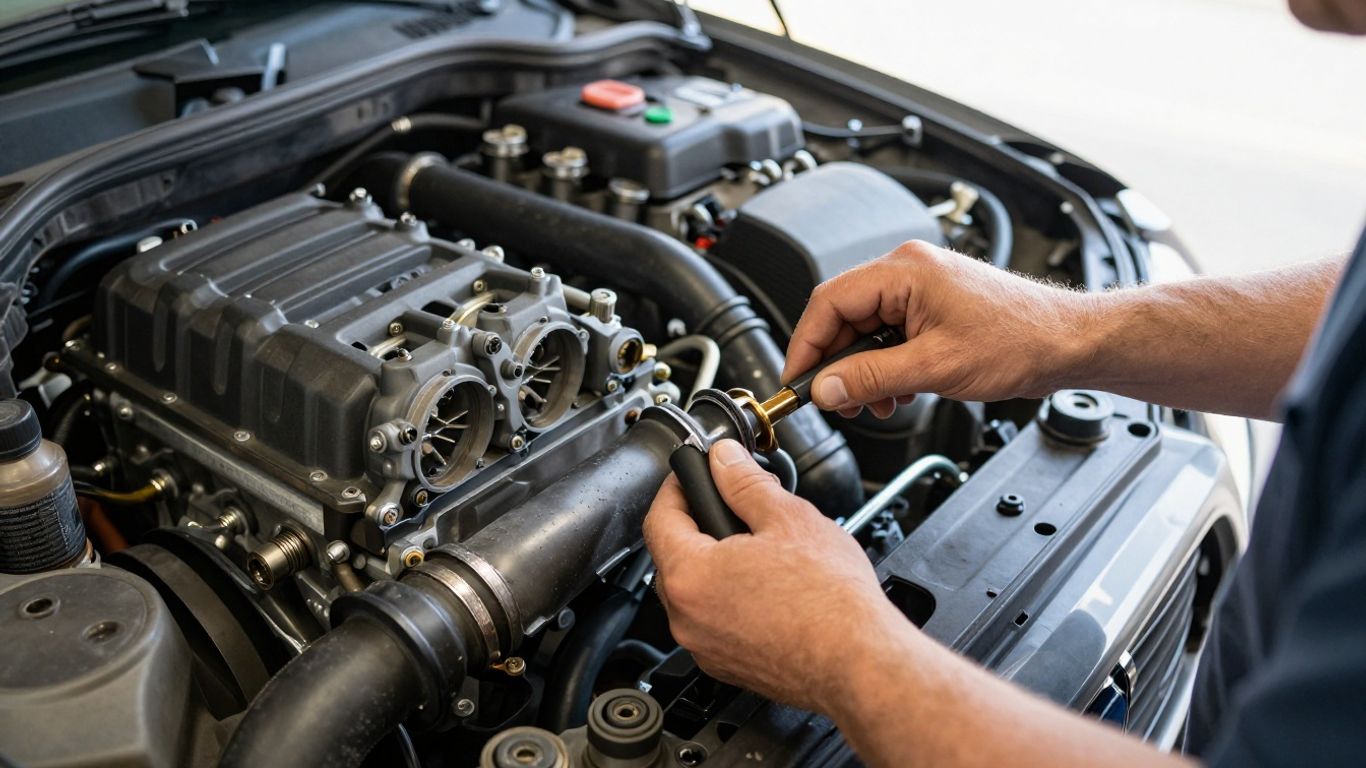
Cleaning the throttle body and airflow sensor
If inspection shows suitable contamination, clean the throttle body using an approved procedure and product. The airflow sensor needs especially gentle handling because its sensing element can be damaged by contact or the wrong solvent. Do not force an electronic throttle plate or flood nearby electrical connectors.
After cleaning, allow the engine to reach operating temperature and check whether idle quality changes. If it does not, return to diagnosis rather than repeating the cleaning indefinitely.
Replacing worn spark plugs
Spark plugs are a reasonable maintenance repair when they are worn, fouled, incorrectly gapped, or overdue according to the engine’s service requirements. Install the specified type and tighten it correctly. A new plug may restore a cylinder, but persistent misfire means the coil, injector, compression, or wiring still needs attention.
Replace plugs as a set when appropriate for the engine and service plan, while keeping any removed parts available for inspection. Their condition can reveal clues about mixture and combustion.
Inspecting and repairing vacuum hoses
Examine hoses for brittleness, splits, soft spots, and loose ends. Replace damaged lines with suitable materials and secure every connection. A hose that looks acceptable may still leak at a hidden underside or fitting.
After the repair, clear relevant codes only if appropriate and repeat the leak check. The idle should be evaluated both immediately and after a normal drive cycle.
Servicing the air filter and intake connections
A restricted or incorrectly fitted air filter can affect airflow, while a loose intake connection can introduce unmetered air. Check that the housing closes evenly and that clamps, ducts, and seals are seated. This is a useful low-cost inspection before pursuing more involved work.
Avoid fitting an unsuitable filter or modifying the intake while troubleshooting. Changes can create new variables and make scan data harder to interpret.
Resetting adaptations after approved repairs
Some repairs may require learned values to be reset or relearned with the correct diagnostic procedure. Do this only after the underlying fault has been repaired and only when the service information calls for it. Resetting adaptations by itself is not a repair.
The engine may need a defined drive cycle before its behavior and monitoring systems settle. Confirm the idle afterward and check whether any warning light returns.
Model-specific rough idle considerations
Engine layout changes the likely causes and the safest testing approach. A small gasoline engine, a large V8, a diesel, and a turbocharged model may all shake at idle for very different reasons. Model year, engine code, mileage, and maintenance history are essential context.
Mercedes four-cylinder gasoline engines
Four-cylinder engines can make a single-cylinder misfire especially noticeable because each cylinder contributes a larger share of the total idle rhythm. Spark plugs, coils, intake leaks, throttle control, and crankcase ventilation deserve early attention. Direct-injection versions may also require a closer look at deposits when other tests do not explain the symptom.
Do not assume that a common engine family has identical parts or procedures across every model year. Verify the engine code before ordering components.
Mercedes V6 and V8 gasoline engines
V6 and V8 engines can mask or redistribute a small fault, but a persistent uneven idle still warrants investigation. Bank-specific codes, intake leaks, ignition components, injector balance, and engine mounts may help narrow the problem. A vibration that changes with transmission engagement can be particularly informative.
Because access can be tight, a professional inspection may save time when several components share a difficult location. Avoid replacing parts simply because one bank is easier to reach.
Mercedes diesel engines and glow plug issues
Diesel roughness immediately after startup can be related to glow-system performance, fueling, air entry, or combustion balance. Smoke color, starting time, outside temperature, and the duration of the roughness are useful observations. A glow plug warning should be investigated rather than treated as a harmless reminder.
Diesel fuel systems operate at high pressure. Leave high-pressure testing and line repairs to a qualified technician unless the procedure and equipment are specifically appropriate.
Turbocharged engines and boost leaks
A boost leak may be most obvious under load, but damaged charge-air plumbing can also affect engine control and idle behavior. Inspect hoses, intercooler connections, clamps, and sensor fittings for looseness or damage. A rough idle that appears alongside poor acceleration deserves an intake and pressure-system inspection.
Do not confuse a boost leak with a small vacuum leak, even though both involve air and may produce overlapping codes. The tests and operating conditions are different.
Start-stop systems and auxiliary battery faults
Start-stop operation adds battery, charging, and control-system variables to the normal idle complaint. An auxiliary battery or voltage problem may cause warnings or disable the feature, but it does not automatically explain a mechanical shake. Check system voltage and stored faults alongside the engine symptoms.
If the engine itself runs unevenly when start-stop is disabled, continue with engine diagnosis. Treat the battery system as one branch of the investigation, not a universal explanation.
When rough idle repairs require a professional
Home inspection is useful for observations and basic maintenance, but some symptoms need equipment and experience. A rough idle can involve compression, timing, high-pressure fuel, electronic throttle control, or internal damage. Delaying a clear warning can turn a manageable repair into a larger one.
Warning signs of serious engine damage
Stop and seek help if there is persistent knocking, heavy smoke, coolant loss, oil pressure warning, severe overheating, or metal in the oil. A sudden loss of power with a violent shake also deserves immediate attention. These signs are not appropriate for trial-and-error parts replacement.
Fluid leaks and unusual exhaust smells add important context. Tell the technician what appeared first and whether the problem followed recent service.
Situations that call for compression testing
Compression testing is appropriate when one cylinder repeatedly misfires, ignition and fueling checks are inconclusive, or the engine has difficult starting and low power. A relative compression test can be a useful first screen, while a traditional test or leak-down test can provide more detail.
The results must be compared between cylinders and interpreted with the engine’s specifications. One number in isolation rarely tells the whole story.
Diagnosing timing and variable valve faults
Timing-chain wear, incorrect valve timing, actuator problems, or sensor faults can produce rough idle, hard starting, and correlation codes. These systems require careful alignment checks and scan data. Replacing a sensor without checking timing may hide the real problem for a short time.
Professional diagnosis is especially sensible when the engine has a history of chain noise or the symptom began after major engine work. Incorrect timing can cause serious damage on some engines.
Estimating repair costs and prioritizing fixes
Ask for a written diagnosis that separates confirmed faults from recommended follow-up work. Begin with safety-related problems and active misfires, then address leaks, maintenance items, and comfort-related vibration. A clear explanation of testing makes an estimate easier to trust.
For broader planning, keep the same habit used when comparing any complex project: separate the primary repair from possible extras. Even an unrelated AI Visibility Engine™ discussion, Nemo Group UK cost guide, Legarreta Eye Care information page, Oli6Goat routine guide, or Main Street Roasters® privacy policy illustrates why scope should be read from the source rather than assumed. Those links are not automotive advice; they are simply reminders not to confuse unrelated information with a repair diagnosis.
Driving risks when the check engine light flashes
A flashing check engine light commonly signals an active misfire that may damage the catalytic converter or leave the vehicle without dependable power. Reduce load, move to a safe location, and arrange prompt assessment. Continuing to drive normally can worsen the fault.
A steady light still deserves diagnosis, but the urgency is different unless the vehicle is shaking badly, losing power, overheating, or showing another warning. When in doubt, prioritize safety over reaching a destination.
How to prevent future Mercedes idle problems
Prevention is mostly consistent maintenance and early attention to small changes. Keep records of parts, fluids, codes, and repairs so a recurring pattern is easier to spot. An engine that gradually becomes less settled is giving you useful information before it becomes a breakdown.
Following the recommended maintenance schedule
Use the schedule appropriate to the exact model, engine, mileage, and service conditions. Oil services, inspections, filters, plugs, and diesel-system checks should not be treated as interchangeable across the range. Confirm what was done and when.
A thorough service record also prevents duplicate work. It gives the next technician a starting point instead of a blank page.
Using the correct fuel and engine oil
Use fuel and oil that meet the vehicle’s specified requirements. The wrong viscosity or specification can affect lubrication, emissions controls, and long-term engine behavior. Avoid assuming that a premium label alone makes a product suitable.
Keep receipts and note any change in idle quality after refueling or an oil service. A sudden change may be relevant evidence, even when it is not the root cause.
Replacing filters and ignition parts on time
Air filters, fuel filters where applicable, spark plugs, and glow plugs all have service considerations. Delayed replacement can increase strain on the systems that control combustion. Inspecting parts at the proper interval is cheaper than waiting for a misfire to become severe.
Use parts that match the engine specification and install them carefully. Small sealing or connection errors can create a new rough-idle complaint.
Addressing warning lights early
A warning light is an opportunity to investigate, not a reason to wait for more symptoms. Read the codes, record when the light appeared, and avoid clearing them before diagnosis. Early testing often limits the number of affected components.
If the light flashes or the vehicle runs violently, stop driving when it is safe to do so. A tow can be less costly than continued misfire damage.
Monitoring changes in idle quality after service
After maintenance, let the engine complete its normal warm-up and observe idle speed, vibration, and accessory response. A brief change during relearning may be expected, but a worsening symptom or returning code needs follow-up. Do not accept a new vibration as normal simply because the original service is complete.
A short log of dates, temperatures, fuel, repairs, and symptoms can reveal whether the problem is repeatable. That information makes future Mercedes rough idle solutions more precise and less speculative.
Conclusion
A rough idle is best handled as a pattern to investigate, not a part to guess at. By recording when it occurs, scanning for codes, checking air, ignition, fuel, and mechanical systems, and escalating serious symptoms promptly, you can move from vague vibration to a defensible repair plan.
Frequently Asked Questions
What is the most common cause of a rough idle?
Common causes include vacuum leaks, worn spark plugs, weak ignition coils, dirty airflow components, fuel-delivery faults, and damaged engine mounts. The most likely cause depends on the engine and the exact symptom pattern.
Can a dirty throttle body cause rough idling?
Yes, contamination can interfere with airflow control and make idle speed unstable. Cleaning may help when dirt is confirmed, but the correct procedure should be followed and other causes should be tested if the symptom remains.
Is a rough idle always caused by a misfire?
No. A failed mount can transmit vibration even when combustion is normal, and intake, fuel, throttle, or timing faults can produce similar sensations. Scan data and physical testing help separate these possibilities.
Why does my engine idle roughly only when cold?
Cold-only roughness can involve intake leaks, ignition weakness, fuel enrichment, glow plugs on diesel engines, or temperature-related sensor behavior. Recording how quickly the engine smooths out gives useful diagnostic information.
Can I drive with a rough idle?
A mild, stable symptom may allow a short trip for diagnosis, but severe shaking, stalling, power loss, overheating, or a flashing check engine light makes continued driving risky. Stop safely and arrange professional help when those signs appear.
Will replacing spark plugs fix a rough idle?
It can if the plugs are worn, fouled, damaged, or incorrectly gapped and are the actual cause. If the idle remains rough, the fault may involve coils, injectors, compression, air leaks, or another system.
When should a rough idle receive professional diagnosis?
Seek professional diagnosis when the engine stalls, a warning light flashes, the problem persists after basic maintenance, or compression, timing, high-pressure fuel, or electronic control systems may be involved. These faults require suitable tools and procedures.